How EVM and VVPAT Systems Work in India
India’s election infrastructure depends not only on voting technology, but also on public trust, operational consistency, verification systems, and institutional transparency. EVM and VVPAT systems sit at the center of this democratic architecture.
In modern democracies, election systems are judged not only by efficiency, but by legitimacy. Citizens must trust that every vote is securely recorded, transparently verified, and institutionally protected.
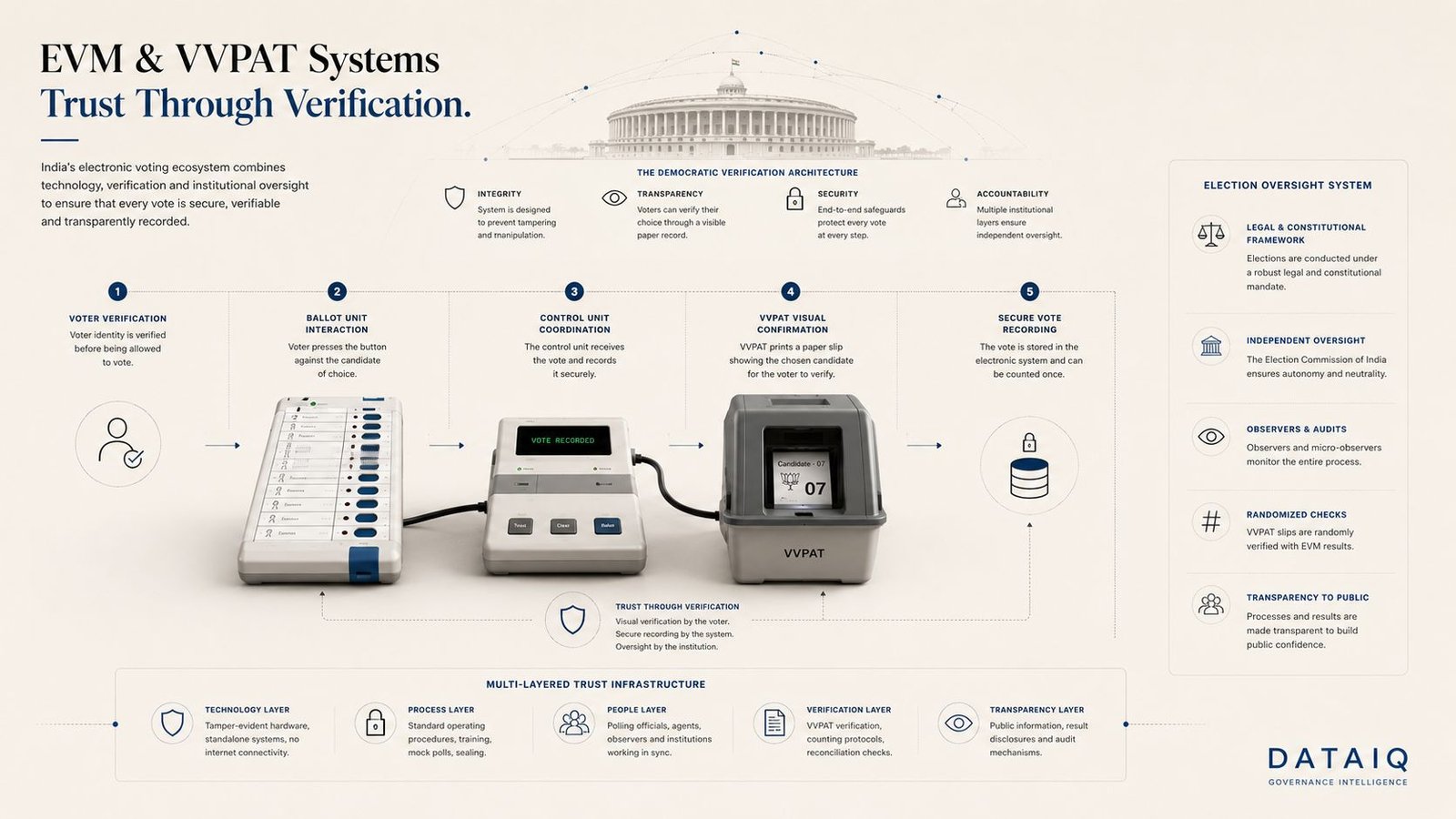
EVM and VVPAT systems operate as part of India’s broader democratic infrastructure involving technology, verification workflows, administrative oversight, and public trust.
Why India Uses Electronic Voting Machines
India’s elections operate at extraordinary scale. Managing paper ballots for hundreds of millions of voters across thousands of constituencies creates significant logistical complexity.
Electronic Voting Machines were introduced to simplify voting workflows, reduce counting delays, standardize electoral procedures, and improve operational efficiency.
Over time, EVMs became one of the most recognizable components of India’s democratic infrastructure.
Ballot Unit
The interface used by voters to select their preferred candidate.
Control Unit
Managed by polling officials to regulate and secure the voting process.
VVPAT Unit
Provides visual confirmation through a temporary paper verification slip.
Simplified Voting Workflow
What VVPAT Adds to the System
VVPAT stands for Voter Verifiable Paper Audit Trail.
When a voter presses a button on the ballot unit, the VVPAT system briefly displays a paper slip showing the selected candidate and symbol before securely storing the slip within the machine.
This adds a physical verification layer to the electronic voting process and strengthens public confidence in electoral recording systems.
Technology Alone Does Not Create Trust
Election systems operate within public trust environments. Citizens must believe not only that technology functions correctly, but also that procedures surrounding the technology remain transparent and accountable.
This is why election infrastructure includes multiple layers of administrative oversight, procedural verification, machine handling protocols, and institutional supervision.
In democracies, trust is ultimately a systems outcome. It emerges from transparency, consistency, verification, and public confidence operating together.
Why EVM Discussions Matter
Discussions around EVMs are not only technological debates. They are also conversations about legitimacy, transparency, institutional confidence, and democratic trust.
Modern democracies increasingly depend on complex technological systems. As these systems become more important, public explainability becomes equally important.
Citizens do not need to become engineers to participate in democracy. But they should be able to understand how critical democratic systems function.
Election infrastructure is not only about recording votes. It is about preserving public confidence in democratic participation.
Understanding Democratic Infrastructure
Democracies rely on institutions, procedures, technologies, and public participation functioning together within trusted systems.
EVM and VVPAT systems represent one part of a much larger electoral architecture designed to coordinate voting at national scale.
Understanding these systems helps citizens engage with democracy through clarity instead of confusion.