How Coalition Politics Shapes India
Coalition politics is one of the defining characteristics of Indian democracy. In a country shaped by extraordinary diversity, alliances often become essential mechanisms for governance coordination, political representation, and democratic stability.
In democracies with enormous regional, linguistic, cultural, and political diversity, governance often depends not on a single political force operating alone, but on multiple groups coordinating representation through alliances.
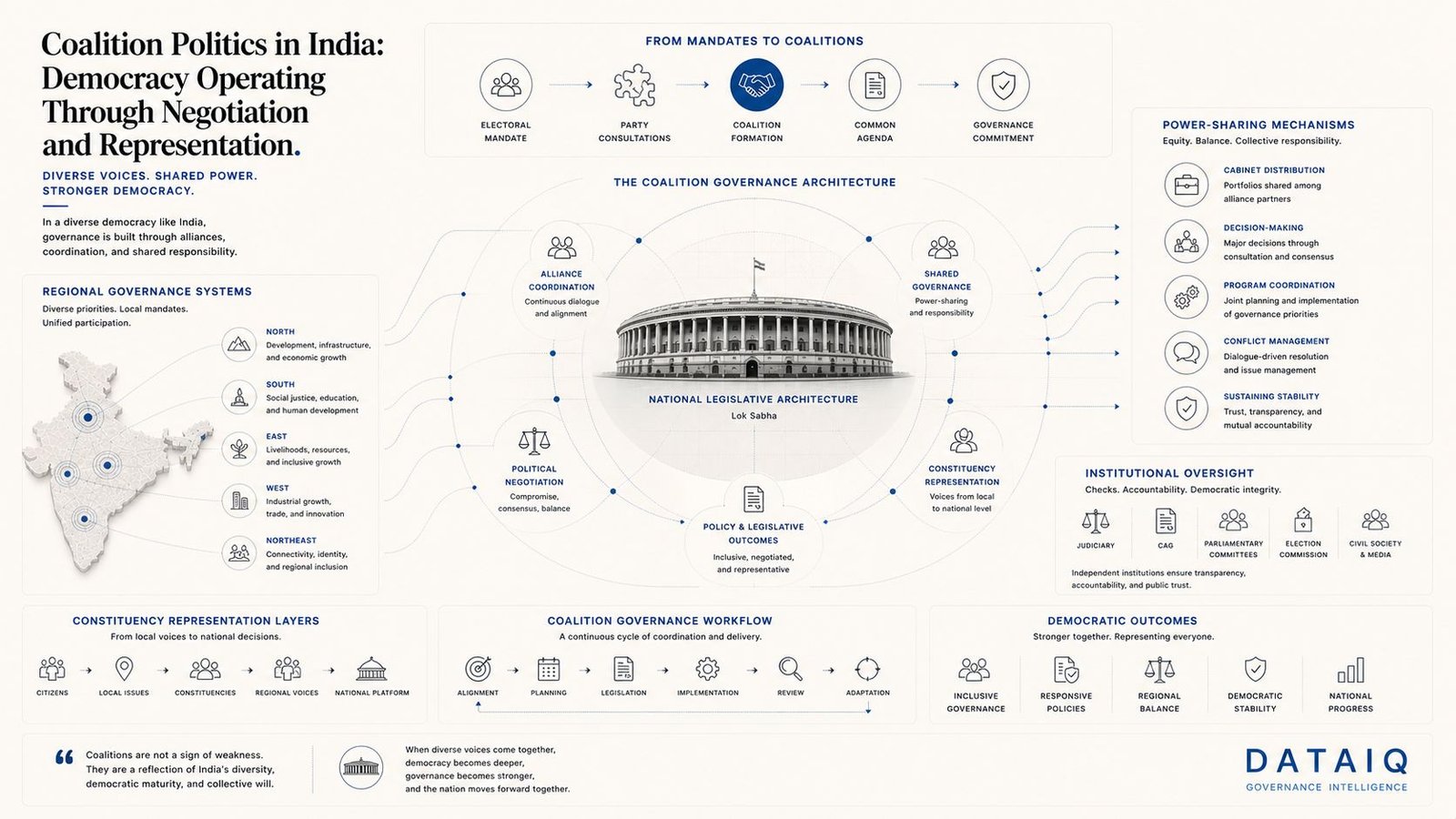
Coalition politics reflects how diverse political, regional, and governance priorities coordinate within India’s democratic system.
What Is Coalition Politics
Coalition politics refers to situations where multiple political parties work together to form a government or coordinate governance.
This usually happens when no single party independently secures enough legislative strength to govern alone.
Coalitions therefore become systems of negotiation, representation, compromise, and political coordination.
Shared Governance
Multiple political groups participate together in governance formation and administration.
Negotiated Coordination
Coalition systems require continuous political coordination and compromise.
Regional Representation
Alliances often bring regional political priorities into national governance systems.
Simplified Coalition Formation Flow
Why Coalitions Are Common in India
India’s political landscape reflects enormous diversity across states, languages, cultures, economies, and regional identities.
Regional political parties often emerge around localized governance priorities, cultural identity, economic concerns, or state-specific political movements.
Coalition politics therefore becomes a natural outcome of democratic representation across a highly diverse society.
Coalitions and Governance Stability
Coalition systems can create both opportunities and challenges for governance.
On one side, coalitions can improve representation by including multiple political voices and regional perspectives within governance systems.
On the other side, coalitions require continuous coordination and political alignment between multiple actors with different priorities.
Regional Politics and National Governance
Coalition politics demonstrates how regional political systems influence national governance in India.
State-level political movements, constituency-level dynamics, and regional governance concerns often shape alliance structures at the national level.
This creates a democratic ecosystem where national politics and regional politics continuously interact with each other.
Coalition politics reflects the reality that governing a diverse democracy often requires coordination across multiple political identities, regional priorities, and systems of representation.
Understanding Democracy Through Alliances
Coalition politics is not simply about political arithmetic. It is also about democratic coordination.
Alliances reflect how representation, diversity, governance priorities, and institutional power interact within a large democratic society.
Understanding coalition systems helps citizens understand democracy not only as competition, but also as negotiation and coordinated governance.