How India Conducts the World’s Largest Election
India’s elections are not just political events. They are one of the largest recurring coordination systems in human history, involving millions of officials, massive logistical planning, constitutional oversight, and public trust operating across extraordinary diversity.
On election day, India activates a democratic system that stretches across mountains, forests, megacities, deserts, islands, and remote villages. Millions of people move in coordination so hundreds of millions of citizens can participate in a process built on logistics, institutional trust, and constitutional legitimacy.
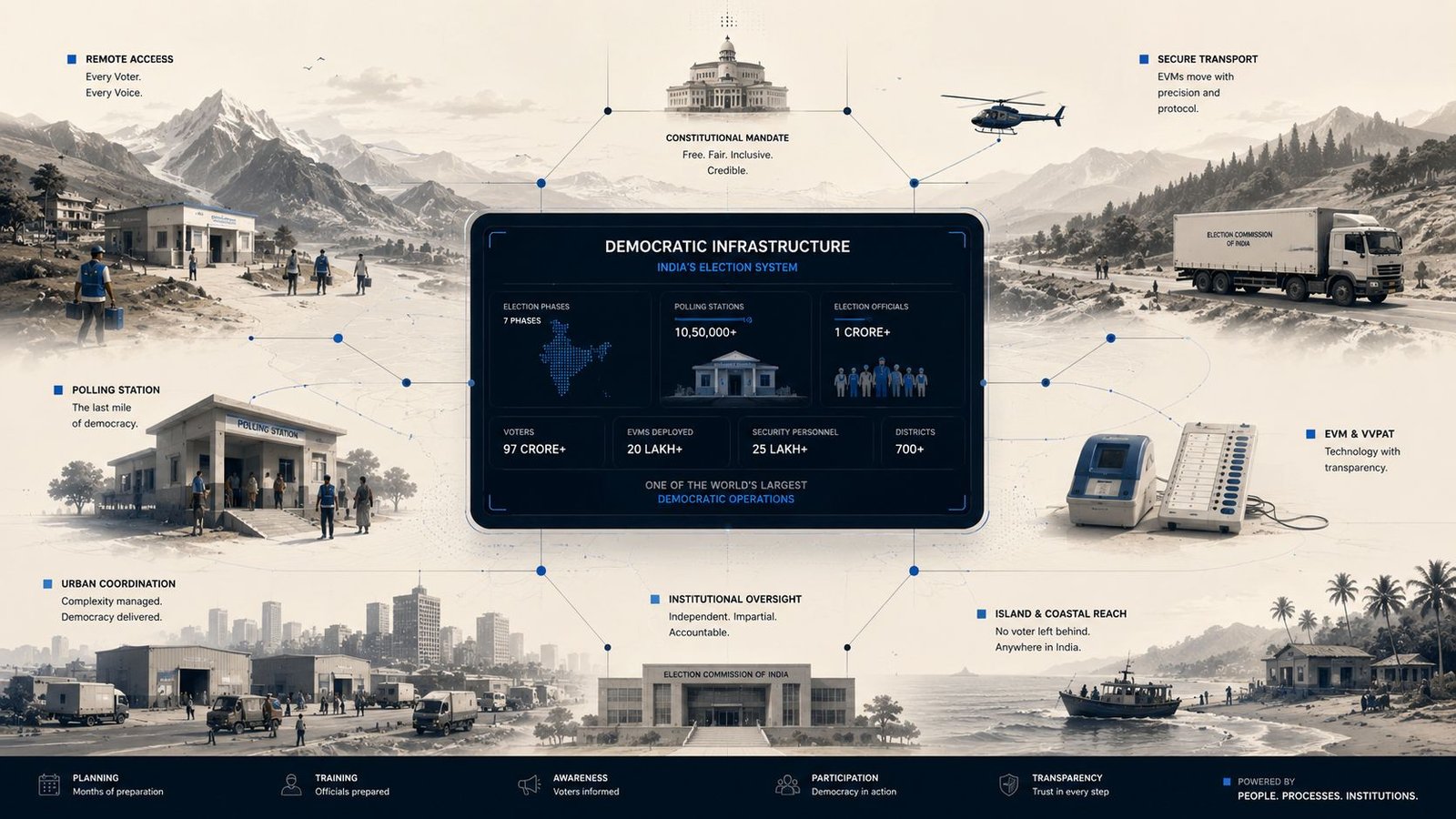
India’s election system operates through large-scale institutional coordination, logistics, verification systems, and democratic infrastructure across diverse geographies.
India Does Not Conduct Elections in a Single Environment
India’s electoral system operates across extraordinary diversity. Every election must adapt simultaneously to linguistic, geographic, demographic, and infrastructural complexity.
A polling station in a Himalayan region operates under completely different conditions from one in a dense metropolitan center. Coastal districts, tribal regions, islands, deserts, and conflict-sensitive areas all require separate logistical planning.
Elections in India are therefore not merely administrative exercises. They are large-scale coordination systems designed to maintain democratic participation across many distinct realities at once.
Geographic Scale
Polling systems must operate across mountains, islands, forests, deserts, and dense urban environments.
Linguistic Diversity
Election communication and administration must function across multiple languages and regional systems.
Human Coordination
Millions of officials, security personnel, and local administrators work together during elections.
The Role of the Election Commission of India
At the center of this infrastructure is the Election Commission of India, the constitutional institution responsible for administering elections across the country.
Its responsibility extends beyond organizing voting days. The institution coordinates scheduling, polling logistics, voter registration systems, counting workflows, constituency administration, security deployment, and electoral supervision at national scale.
More importantly, the institution operates as a trust infrastructure. Democratic systems function only when citizens believe the process itself is legitimate, transparent, and operationally stable.
Simplified Election Infrastructure Flow
Why Elections Happen in Phases
India’s elections are often conducted in multiple phases. This is not simply a political decision. It is largely an operational necessity.
Security personnel, election officials, transportation systems, polling infrastructure, and monitoring resources must move carefully across regions in a coordinated manner.
Conducting elections in phases allows administrative systems to maintain consistency, supervision, and security at national scale.
EVM and VVPAT Systems
Electronic Voting Machines and VVPAT systems form a critical part of India’s election infrastructure.
EVMs are designed to standardize and simplify the voting process, while VVPAT systems add a physical verification layer that allows voters to visually confirm their vote before it is securely recorded.
Together, these systems are intended to support both operational efficiency and public confidence. In democratic systems, trust is as important as technology.
The Human Layer Behind Democracy
Elections are often discussed through numbers, seats, percentages, and political outcomes. But underneath the statistics is a vast human coordination effort.
Polling officers travel to remote regions carrying voting infrastructure through difficult terrain. Security personnel monitor sensitive locations. Administrative teams work under strict procedural timelines.
The scale of India’s democracy is not sustained by technology alone. It is sustained by institutional coordination and human participation operating together.
India’s elections are not merely about selecting governments. They are recurring demonstrations of how public trust, institutional coordination, and democratic participation function together across extraordinary diversity.
Why Understanding Election Systems Matters
Democracies are often discussed through outcomes. But outcomes cannot be fully understood without understanding the systems underneath them.
Election infrastructure influences public trust. Administrative design shapes participation. Institutional transparency affects legitimacy.
Understanding democratic systems is therefore not only relevant during election season. It is part of understanding how modern societies coordinate power, representation, and public participation.