How Political Narratives Spread in Modern India
Modern politics operates not only through institutions and elections, but also through narratives. In India’s digital era, political stories, emotional signals, media ecosystems, and public conversations spread rapidly across interconnected communication systems.
Political influence in modern democracies increasingly depends on the ability to shape narratives, sustain attention, create emotional resonance, and move ideas across interconnected public communication ecosystems.
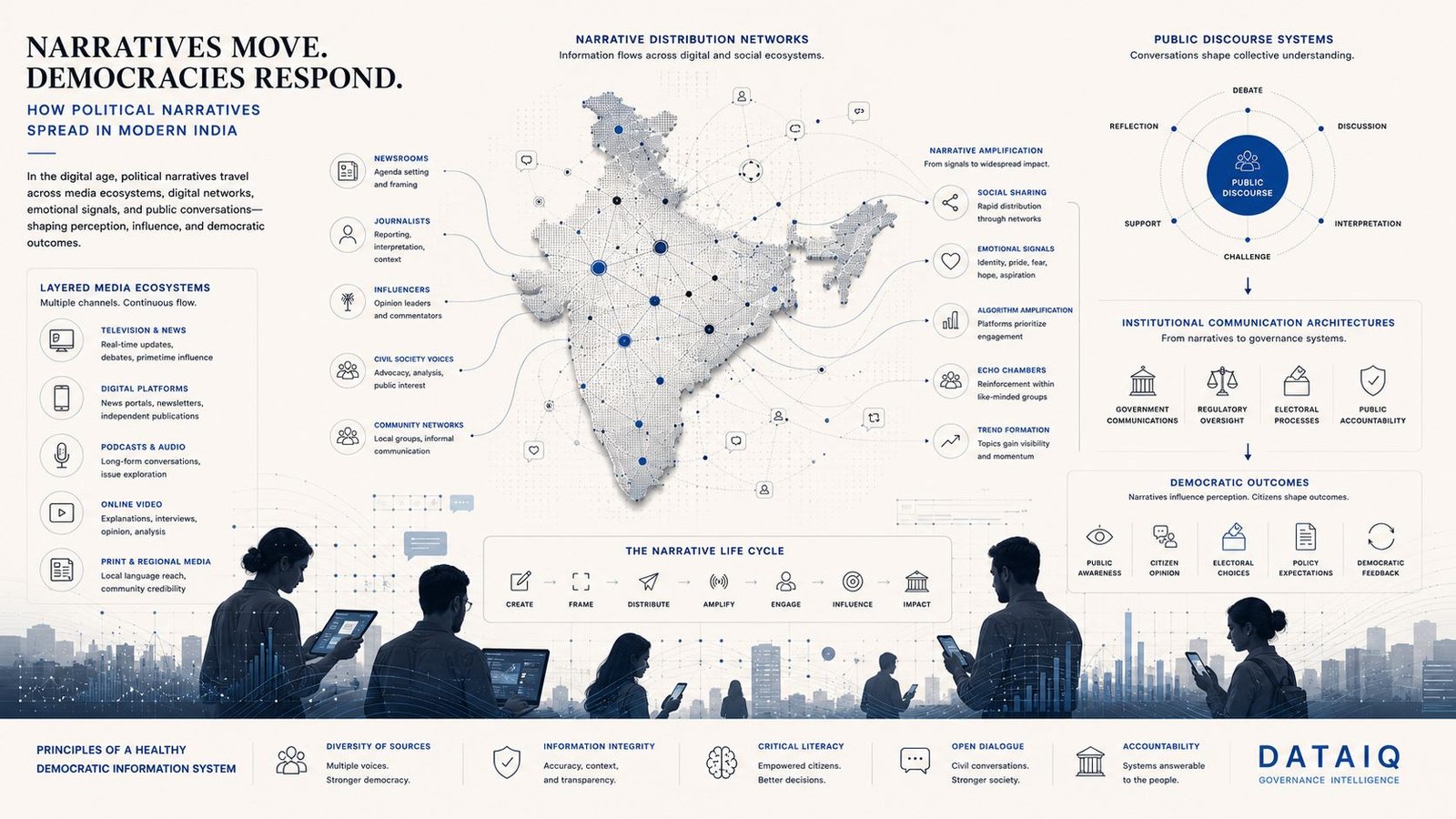
Political narratives move through interconnected communication ecosystems shaped by media, digital platforms, emotional messaging, and public participation.
Politics Is Also a Communication System
Elections are often understood through governance outcomes and voting numbers. But democratic systems also operate through communication ecosystems.
Speeches, interviews, campaign messaging, public symbols, media coverage, digital conversations, and community discussions all contribute to how political narratives spread.
Modern political influence therefore depends not only on institutional power, but also on narrative visibility and communication reach.
Media Ecosystems
Television, digital media, podcasts, and news platforms shape public political visibility.
Emotional Messaging
Narratives often spread faster when they connect with identity, aspiration, emotion, or belonging.
Networked Distribution
Social platforms allow narratives to move rapidly through interconnected digital communities.
Simplified Narrative Spread Flow
Why Emotional Narratives Matter
Political communication is not always driven only by policy discussions or institutional analysis.
Narratives often become influential when they connect with public identity, cultural memory, aspiration, fear, pride, or emotional belonging.
This emotional layer is one reason why political messaging spreads rapidly across communities and digital ecosystems.
Digital Platforms and Political Visibility
Digital platforms have transformed how political narratives spread in modern India.
Short-form video platforms, messaging systems, social media networks, livestreams, online creators, and digital communities now influence political visibility and public attention at unprecedented speed.
Political communication increasingly operates within algorithm-driven attention ecosystems.
Narratives, Identity, and Democracy
Political narratives do more than communicate information. They shape identity, influence perception, and affect how citizens emotionally relate to governance and public issues.
In diverse democracies, narratives help people interpret institutions, leadership, public trust, and political events.
Understanding narrative systems therefore becomes increasingly important for understanding modern democratic behavior.
Modern political influence depends not only on governing institutions, but also on the ability to shape public narratives across interconnected communication systems.
Understanding Democracy in the Narrative Era
Democracies today operate within large-scale communication ecosystems where information, emotion, identity, and attention interact continuously.
Political narratives shape public understanding, influence participation, and affect how citizens perceive institutions and leadership.
Understanding narrative systems helps citizens understand democracy not only as governance, but also as an evolving communication environment.