Inside the Architecture of India’s Electoral System
India’s electoral system is not a single process operating in isolation. It is a layered democratic architecture involving constitutional institutions, parliamentary structures, state assemblies, constituencies, administrative systems, and public participation working together at national scale.
Elections are often discussed through campaigns, speeches, and outcomes. But underneath every result is a carefully designed democratic structure that determines representation, administration, accountability, and political coordination across a nation of extraordinary scale.
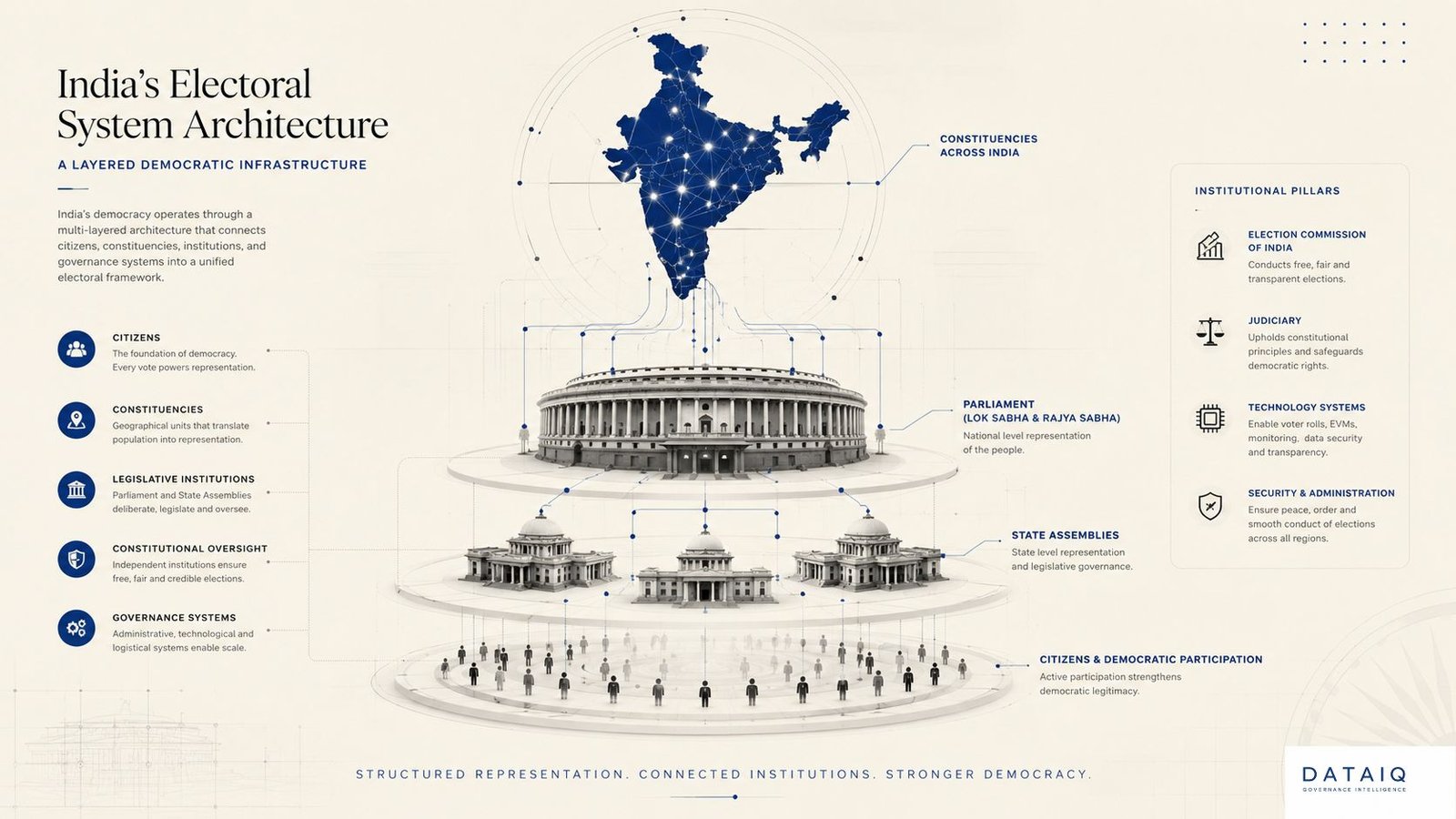
India’s electoral system operates through layered structures of representation, constituencies, legislative institutions, and democratic coordination.
Democracy Operates Through Structure
India’s democracy is often experienced through voting day. But voting is only the visible layer of a much larger institutional architecture.
The electoral system defines how representation is distributed, how governments are formed, how constituencies are organized, and how public participation translates into political power.
Understanding this structure is essential for understanding Indian democracy itself.
Lok Sabha
Represents citizens at the national level through directly elected Members of Parliament.
Rajya Sabha
Functions as the Council of States and represents state interests within Parliament.
State Assemblies
Govern state-level legislative processes through elected representatives.
Simplified Electoral Architecture
Why Constituencies Matter
Constituencies are one of the most important units within India’s electoral structure. They connect public participation to political representation.
Every constituency represents a geographic region whose voters collectively elect a representative. These representatives then participate in legislative processes and governance decisions.
Elections therefore do not simply operate at national scale. They operate through thousands of localized democratic environments.
Representation and Scale
India’s electoral architecture must balance representation across vast population differences, regional priorities, linguistic diversity, and state-level governance structures.
This creates a system where national politics and regional politics continuously interact with each other. State-level political dynamics often influence national governance, while national issues can reshape regional electoral behavior.
India’s democratic structure is therefore not centralized in a single layer. It functions through interconnected levels of representation.
Elections and Governance Are Deeply Connected
Electoral systems do more than determine winners and losers. They shape governance itself.
Representation affects policymaking. Constituency structures influence public accountability. Electoral participation shapes political legitimacy.
Understanding electoral architecture therefore helps explain how democratic societies organize power, participation, and public decision-making.
India’s democracy functions through layered systems of representation, coordination, participation, and institutional design. Elections are not isolated events. They are expressions of a much larger democratic architecture.
Why Electoral Literacy Matters
Democracies become healthier when citizens understand not only political outcomes, but also the systems underneath those outcomes.
Electoral literacy strengthens public awareness, improves civic understanding, and creates deeper engagement with democratic institutions.
In a democracy as large and complex as India’s, understanding the architecture matters as much as understanding the result.