What Happens Between Voting Day and Result Day
Election day is only one visible stage within a much larger democratic workflow. After voting concludes, a carefully coordinated system involving security protocols, machine handling, administrative oversight, and counting infrastructure begins operating behind the scenes.
When voting ends, the election process does not stop. It enters another phase where administrative precision, security coordination, procedural verification, and institutional trust become critically important.
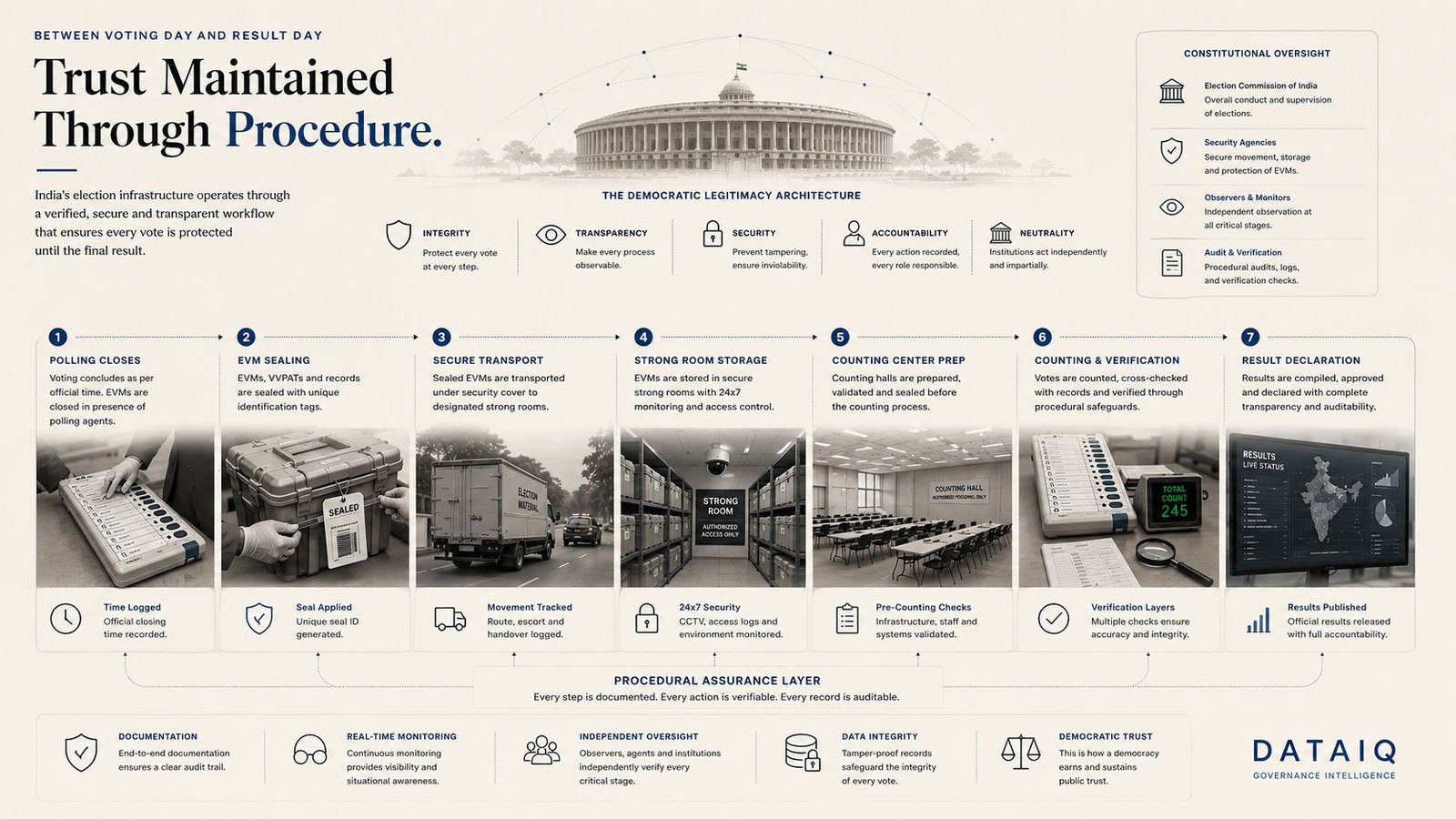
India’s election infrastructure continues operating after voting concludes through coordinated workflows involving security, transportation, storage, verification, and counting systems.
Voting Day Is Only One Layer of the System
Most citizens experience elections through polling booths and voting queues. But once polling officially closes, a separate infrastructure begins operating across the country.
Election officials secure voting machines, complete procedural documentation, seal equipment, coordinate transportation, and prepare counting centers under monitored workflows.
This stage is essential because democratic legitimacy depends not only on voting itself, but also on how votes are handled after polling concludes.
Simplified Post-Voting Workflow
Sealing and Documentation
After polling closes, election officials complete multiple procedural steps before voting machines leave the polling station.
EVMs and associated records are sealed according to established protocols. Documentation processes are completed and procedural verification checks are conducted.
These procedures are designed to maintain consistency, traceability, and administrative accountability throughout the election workflow.
Sealing Protocols
Voting systems and associated records are secured after polling concludes.
Transportation Security
Machines are moved under monitored and coordinated security arrangements.
Counting Centers
Dedicated counting environments are prepared before official result processing begins.
Why Counting Takes Time
Election counting is not simply a rapid data-processing activity. It is a monitored administrative process involving procedural verification and institutional oversight.
Counting workflows are designed to prioritize accuracy, consistency, and legitimacy over speed. Officials verify records, process votes systematically, and follow procedural protocols throughout the counting cycle.
In democratic systems, delayed certainty is often considered preferable to rushed confusion.
Security and Institutional Trust
Post-voting election workflows depend heavily on security coordination and institutional procedures.
Secure storage environments, monitored transportation systems, procedural supervision, and controlled counting centers all contribute to maintaining electoral trust.
Democratic systems operate effectively only when citizens trust both the visible and invisible layers of the process.
Election infrastructure is not only about recording participation. It is also about protecting the chain of trust between voting and results.
Understanding the Invisible Layer of Elections
Election day receives most public attention, but democratic systems depend equally on what happens after polling concludes.
Administrative coordination, procedural discipline, logistical security, and counting infrastructure all contribute to electoral legitimacy.
Understanding these invisible layers helps citizens understand democracy not only as an event, but as a coordinated institutional system.