What Is a Constituency and Why Does It Matter
Constituencies are one of the foundational layers of democratic representation. They connect citizens to governance systems, organize electoral participation, shape political competition, and determine how local realities influence public decision-making.
Democracies do not function only through national elections or political leadership. They function through localized systems of representation where citizens, geography, governance priorities, and public participation intersect within structured democratic architecture.
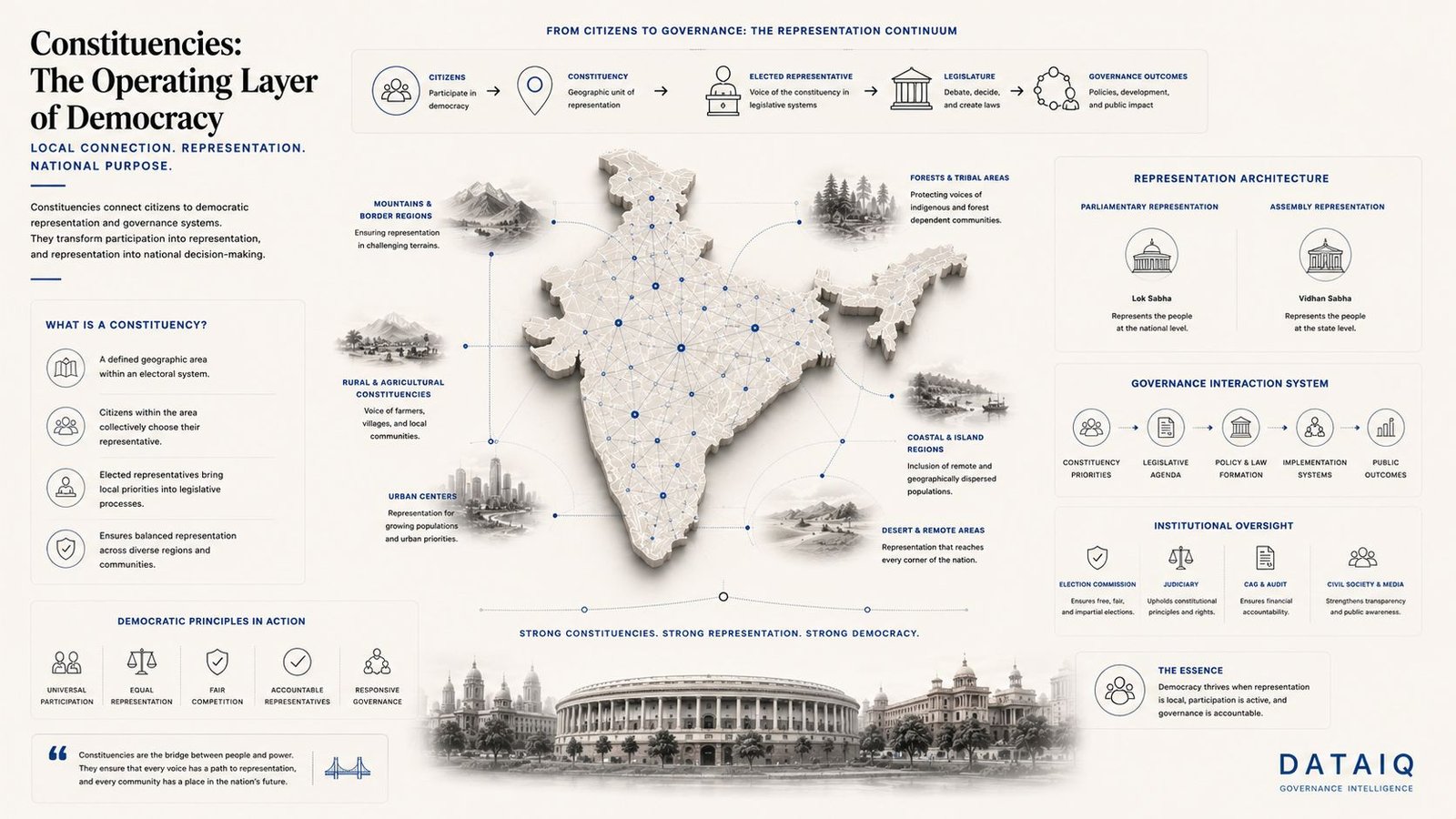
Constituencies operate as the foundational representation layer connecting citizens, local realities, elections, governance systems, and legislative participation.
Understanding the Basic Structure
A constituency is a geographic area represented by an elected public representative within a democratic system.
Citizens within that region collectively participate in choosing a representative who will carry constituency interests into legislative and governance systems.
In practical terms, constituencies are the mechanism through which democratic participation becomes organized political representation.
Geographic Representation
Every constituency represents a defined geographic region within the electoral system.
Democratic Participation
Citizens within the constituency collectively participate in selecting representation.
Governance Linkage
Representatives connect constituency priorities to legislative and governance systems.
Simplified Democratic Representation Flow
Why Constituencies Shape Politics
Democratic competition operates constituency by constituency.
Different constituencies often contain different demographic realities, governance priorities, economic conditions, infrastructure needs, and political histories.
As a result, electoral behavior can vary significantly across regions even within the same state or national election cycle.
Constituencies and Governance Systems
Constituencies influence governance because elected representatives are expected to engage with localized public concerns and regional development priorities.
Infrastructure, healthcare, employment, agriculture, education, transportation, urban growth, and welfare priorities often differ substantially from one constituency to another.
This creates a democratic structure where governance systems remain connected to ground-level realities.
Representation Beyond Elections
Constituencies are not relevant only during election campaigns.
They continue functioning as active units of governance interaction, public accountability, political communication, and representative engagement.
Understanding constituencies therefore helps explain how democratic systems operate continuously beyond voting cycles.
Democracy becomes meaningful when representation remains connected to communities, public priorities, and localized realities.
Understanding the Local Layer of Democracy
Democracies are often discussed through national politics and major political figures. But representation begins at a much more localized institutional layer.
Constituencies are where public participation becomes structured political representation and where governance systems remain connected to communities.
Understanding constituencies helps citizens understand democracy not only as national politics, but as a representation system built from local participation upward.