Why Regional Politics Matters in India
India’s democracy is not shaped only through national political narratives. Regional political systems play a central role in representation, governance priorities, coalition structures, cultural identity, and democratic participation across the country.
India does not function politically as a single uniform environment. It operates through multiple regional political ecosystems shaped by language, culture, economic priorities, local leadership, historical movements, and state-level governance realities.
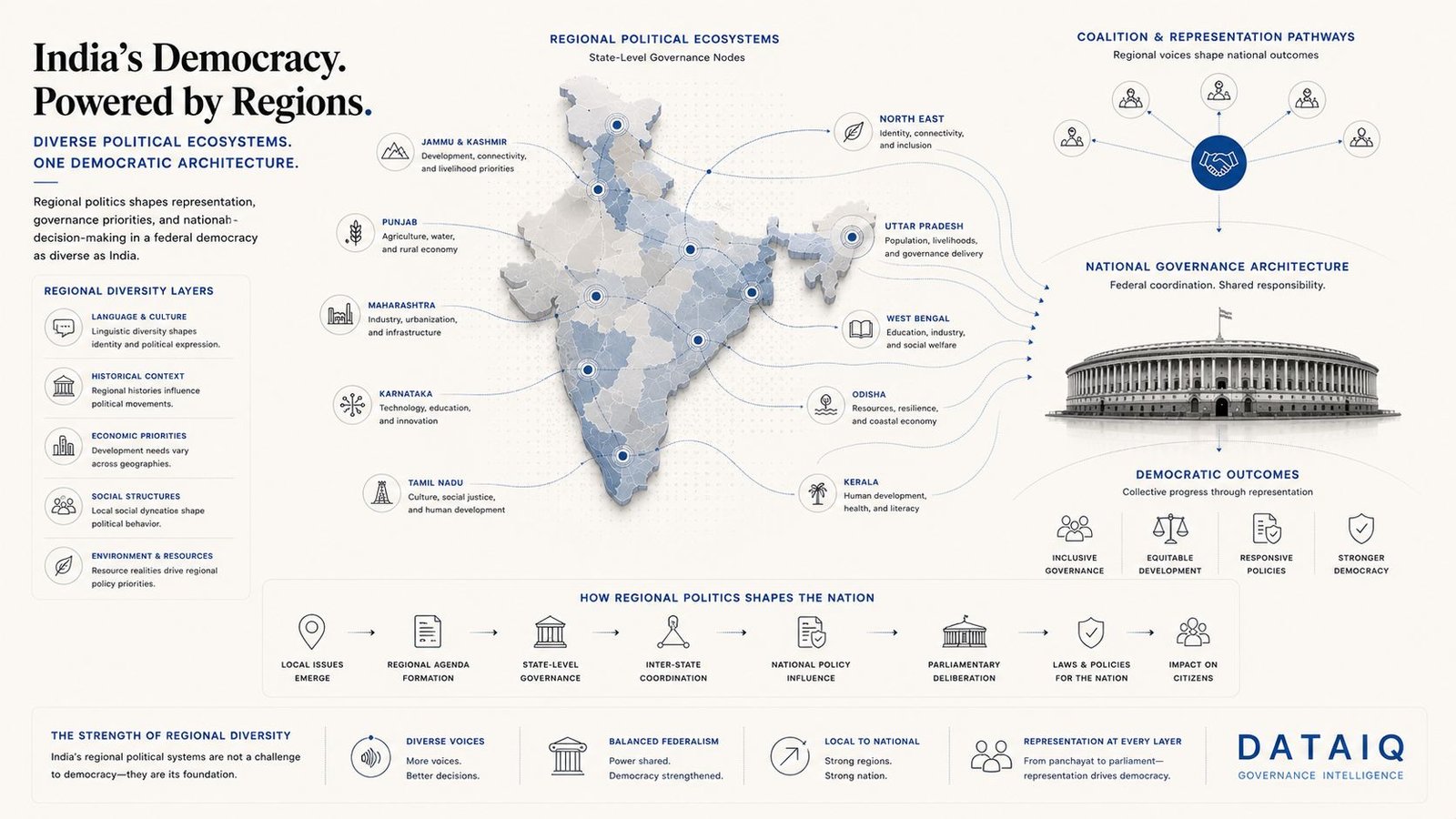
Regional politics shapes governance priorities, democratic participation, coalition systems, and representation across India’s diverse political landscape.
India Contains Multiple Political Environments
Political priorities often vary significantly from one state to another.
Issues related to agriculture, industrial growth, language identity, employment, regional development, urbanization, water access, migration, education, and infrastructure can shape political behavior differently across regions.
As a result, regional politics becomes one of the most important layers within India’s democratic system.
Cultural Identity
Language, culture, and regional identity often influence political movements and voter behavior.
Local Governance Priorities
Different states often focus on different governance and development priorities.
Regional Leadership
State-level political leaders and movements can shape long-term democratic behavior.
Simplified Regional Political Flow
Regional Parties and Representation
Regional political parties often emerge around state-specific concerns, cultural identity, governance priorities, or historical political movements.
These parties can become highly influential because they remain closely connected to localized realities and constituency-level concerns.
In many cases, regional political systems shape national coalition structures and influence central governance decisions.
Why Regional Politics Influences National Politics
India’s parliamentary system creates continuous interaction between state-level politics and national governance.
Electoral performance in individual states can significantly influence coalition structures, parliamentary strength, policy priorities, and governance stability.
National politics in India therefore cannot be fully understood without understanding regional political ecosystems.
Regional Politics as Democratic Diversity
Regional politics demonstrates how democratic systems adapt to diversity instead of forcing uniformity.
Different political environments allow different communities and regions to express distinct governance priorities and political identities.
This diversity becomes one of the defining characteristics of Indian democracy.
Regional politics is not separate from Indian democracy. It is one of the primary ways India’s democratic diversity expresses itself.
Understanding Democracy Beyond National Headlines
National political narratives often dominate public attention. But India’s democratic system operates through many regional political realities simultaneously.
Regional politics shapes governance priorities, coalition systems, public representation, and electoral behavior across the country.
Understanding regional political ecosystems helps citizens understand Indian democracy as a layered and deeply diverse system rather than a single centralized narrative.